
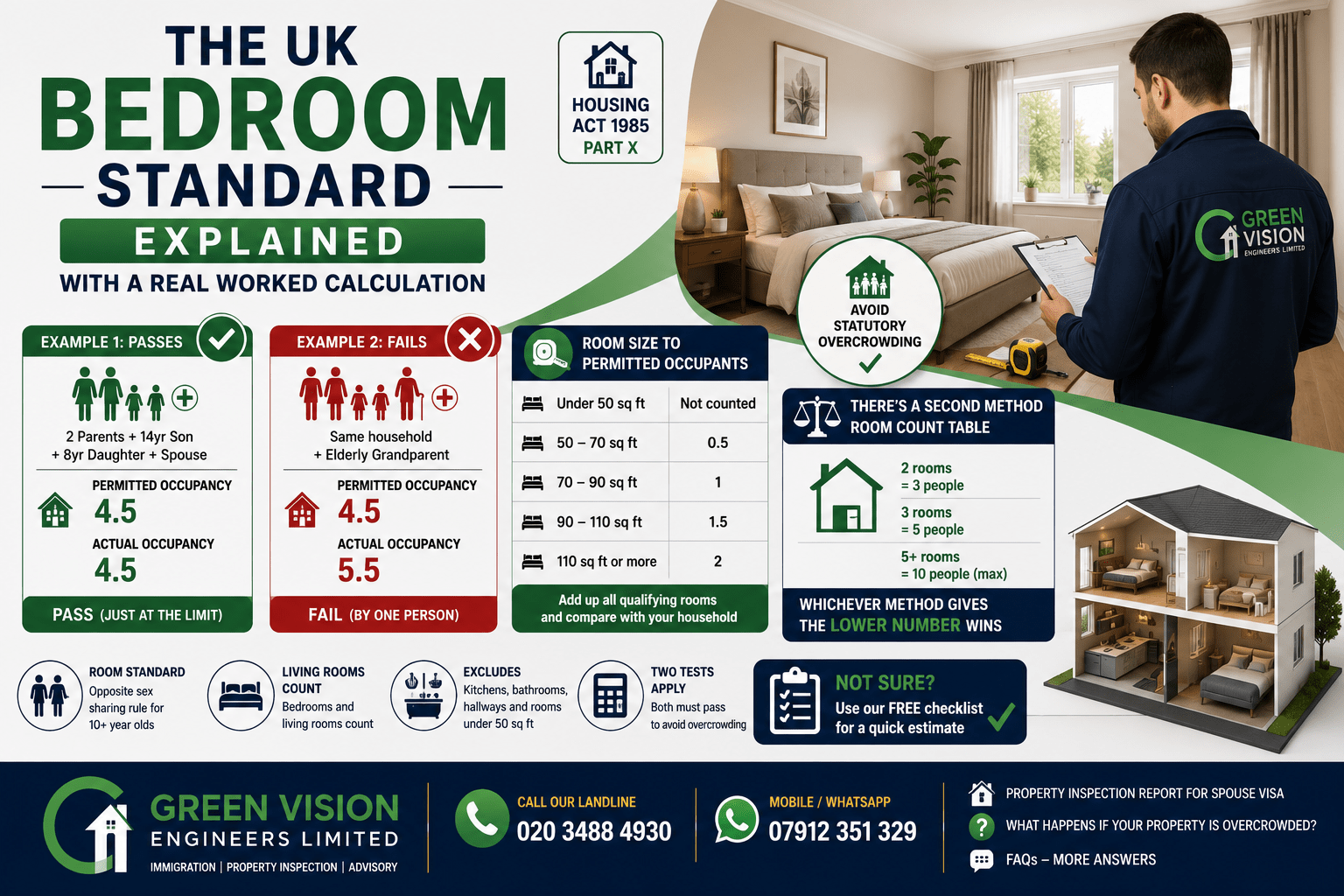
The UK Bedroom Standard Explained, With a Real Worked Calculation
The UK Bedroom Standard Explained, With a Real Worked Calculation
Most explanations of overcrowding rules stop at definitions: room standard means this, space standard means that, without ever showing the actual sums. Numbers make this clearer than definitions do, so here are two worked examples using real figures, followed by what counts as a room and what doesn’t, and a second calculation method that most guides skip entirely.
The Space Standard, Worked Through
Take a household applying for a visa: two parents, a 14-year-old son, an 8-year-old daughter, and a spouse about to join them. The property has three genuine bedrooms.
- Bedroom A measures 130 square feet, permitted occupancy 2 people
- Bedroom B measures 95 square feet, permitted occupancy 1.5 people
- Bedroom C measures 75 square feet, permitted occupancy 1 person
Total permitted occupancy across all three rooms comes to 4.5 people.
Now count the household. Two parents count as 2. The 14-year-old counts as 1. The 8-year-old, being under 10, counts as half a person under the space standard. That’s 3.5 already living there. Add the spouse joining them, and the total becomes 4.5.
Permitted occupancy: 4.5. Actual occupancy: 4.5. This property passes, but only just, right at the exact limit rather than comfortably under it.
The Same Household, One Change, a Different Result
Change one detail: suppose an elderly grandparent is also moving in alongside the spouse. That adds a full extra person, bringing actual occupancy to 5.5 against a permitted capacity of 4.5. The same property, with the same three bedrooms, now fails the space standard by a full person’s worth of space.
This is exactly why a rough sense of “there’s probably enough room” can be misleading. Small changes in who’s moving in can flip a pass into a fail, and the only way to know for certain is to measure the actual rooms and run the calculation properly.
The Room Standard, Checked Separately
The room standard is a different test, and it doesn’t care about square footage at all. It asks a single question: does anyone aged 10 or over, who isn’t a couple, have to share a bedroom with someone of the opposite sex? In the household above, the parents share a room as a couple, the son has his own room, and the daughter has her own room. No breach occurs, regardless of how the space standard calculation comes out.
A property can pass the room standard while still failing the space standard, or the other way around. Both tests apply independently, and either one failing counts as statutory overcrowding.
What Counts as a Room, and What Doesn’t
Bedrooms and living rooms both count toward these calculations, since either could reasonably be used for sleeping. Kitchens, bathrooms, and hallways don’t count. A room measuring under 50 square feet is excluded entirely from both tests, treated as too small to count at all rather than being given a fractional value.
Quick Reference: Room Size to Permitted Occupants
| Room floor area | Permitted occupants |
| Under 50 sq ft | Not counted |
| 50 to 70 sq ft | 0.5 |
| 70 to 90 sq ft | 1 |
| 90 to 110 sq ft | 1.5 |
| 110 sq ft or more | 2 |
Add up the permitted occupants across every qualifying room to get your property’s total capacity, then compare that against your actual household count using the same half-person rule for children aged 1 to 9 shown in the worked example above.
There’s a Second Method, and the Lower Result Wins
The room-by-room calculation above isn’t the only test that applies. A second method looks purely at how many rooms and living rooms a property has in total, regardless of individual room sizes, using a fixed table of permitted occupants based on room count alone. A property with two rooms available for sleeping permits 3 people under this method. Three such rooms permit 5, rising to a maximum of 10 people once five or more rooms are available.
Whichever of the two methods produces the lower permitted number is the one that actually applies. In practice, this means a property with several unusually large rooms might still be capped by the simpler room-count test, even where the size-based calculation alone would allow more people. Working through both tests properly, rather than relying on just one, is exactly the kind of detail a professional inspection accounts for automatically.
Why This Matters More Than the Definitions Alone
Knowing that a room standard and a space standard exist doesn’t tell you whether your specific property passes. The worked examples above show how close a genuine borderline case can be; a single additional occupant made the difference between passing and failing in the same property. This is exactly the kind of detail a professional inspection settles with actual measurements, rather than an estimate based on how a room looks.
The full legal basis for both tests sits in Part X of the Housing Act 1985, and Shelter England publishes a plain-language overcrowding checker if you want to work through your own numbers before booking anything.
Frequently Asked Questions
Do I need to measure every room myself before booking an inspection?
No, a professional surveyor measures everything accurately during the visit. Working through the maths yourself beforehand is useful for a rough sense of where you stand, not a substitute for an actual measurement.
What happens if my property fails by a small margin, like half a person?
A small margin failure still counts as statutory overcrowding under the space standard. There’s no informal rounding or leniency built into the calculation.
Does furniture or storage space reduce a room’s usable floor area for this calculation?
The calculation is based on the room’s floor area, not how it’s currently furnished, though a surveyor measuring in person will account for genuinely unusable space where relevant.
Can a large living room make up for a small bedroom shortfall?
Yes, living rooms count toward total permitted occupancy in the same way bedrooms do, provided they meet the same minimum size threshold.
Does the room standard ever override a space standard pass?
Yes, both tests apply independently. A property can pass the space standard calculation and still fail if it breaches the room standard’s opposite sex sharing rule, or vice versa.
Which of the two space standard methods actually applies to my property?
Both are checked, and whichever produces the lower permitted number is the one that applies. A professional inspection works through both automatically rather than leaving you to guess which one is stricter for your specific property.
Want Your Own Numbers Checked Properly?
Use our free checklist to get a rough sense of where you stand, then book a proper measurement if you’re anywhere near the borderline.
Call our landline on 020 3488 4930 or mobile/WhatsApp on 07912 351 329.
See our Property Inspection Report for Spouse Visa page, read what happens if your property is overcrowded, what comes next if you’re close to the limit, or contact us to book. More answers on our FAQs page.