
HHSRS Category 1 and 2 Hazards: What a Surveyor Is Actually Checking For
HHSRS Category 1 and 2 Hazards: What a Surveyor Is Actually Checking For
HHSRS doesn’t work like a pass-or-fail checklist. It scores each potential hazard by risk, then sorts the result into Category 1 or Category 2. Here’s how that scoring actually works, with real examples of what surveyors look for.
How a Hazard Gets Its Category
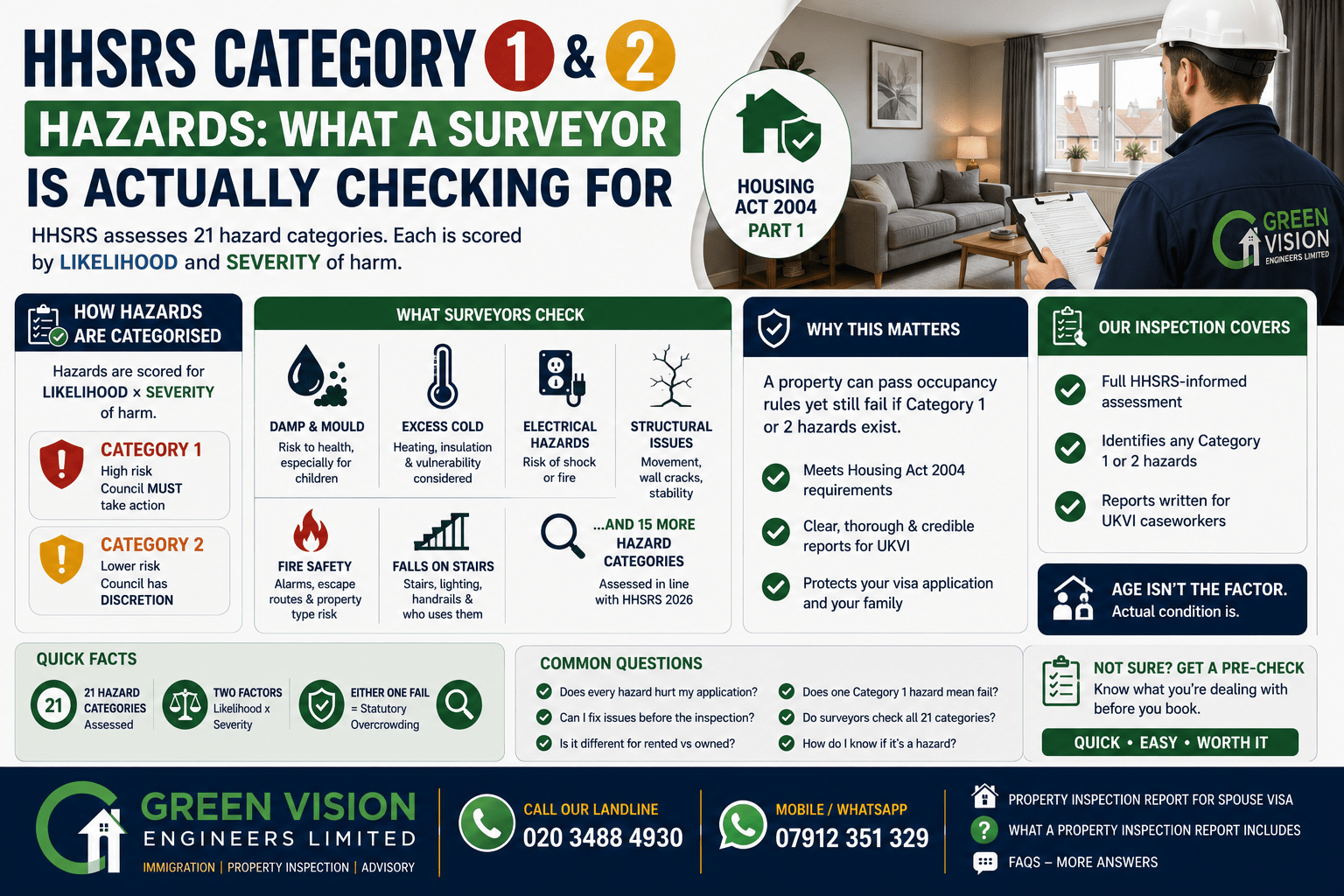
Under the current 2026 operating guidance, HHSRS assesses 21 hazard categories, reduced from the original 29 categories set out when the system launched in 2006. Assessors score each hazard by combining two factors: how likely it is to cause harm, and how serious that harm would be if it happened. A high combined score places the hazard in Category 1. A lower score places it in Category 2.
Local authorities must take enforcement action whenever a Category 1 hazard exists. Category 2 hazards give them discretion rather than an obligation. That distinction matters for landlords and councils, and it also shapes how a surveyor writes up your visa property report.
What This Actually Looks Like in a Property
Damp and mould growth. A small amount of condensation on a bathroom window rarely scores highly. Persistent black mould across a bedroom wall, especially where a child sleeps, can score into Category 1 territory because of the respiratory risk involved.
Excess cold. Poor insulation combined with an unreliable heating system gets assessed against how vulnerable the likely occupants are. A property that’s merely a bit chilly scores differently to one with no working heating at all going into winter.
Electrical hazards. Exposed wiring or an outdated fuse box scores based on genuine risk of shock or fire, not just its age. A visibly old but properly maintained system can score lower than a newer installation with a specific fault.
Structural collapse. Cracking that’s cosmetic and stable scores very differently to cracking that suggests genuine structural movement. This is exactly the kind of judgement call that needs a trained surveyor rather than a guess.
Fire safety. A missing smoke alarm scores differently depending on the property type. A shared house with several unrelated tenants carries a higher risk profile than a single-family home, so the same missing alarm can score higher in one setting than another.
Falls on stairs. Loose carpet, poor lighting, or a missing handrail all feed into this score. Surveyors look at who’s likely to use the stairs too. A household with young children or an elderly relative raises the risk calculation even if the stairs themselves look fine to an untrained eye.
Why This Matters for Your Visa Report
Your report doesn’t just need to confirm your property isn’t overcrowded. It also needs to confirm the absence of Category 1 or 2 hazards under the Housing Act 2004. A property can pass every occupancy calculation and still cause a problem if a genuine hazard goes unnoticed or unreported.
Caseworkers see a lot of reports. A report that clearly addresses hazard assessment, not just room measurements, reads as more thorough and more credible. It signals that the surveyor actually inspected the property properly, rather than just pulling out a tape measure and leaving.
One Detail That Catches Applicants Off Guard
Families often assume an older property is automatically more likely to fail this part of the assessment, while a newer one sails through. That’s not always true. We’ve seen modern flats flagged for poorly ventilated bathrooms leading to mould, and older Victorian houses pass comfortably because previous owners had already addressed damp and electrical issues properly. Age isn’t the deciding factor. Actual condition is.
This is exactly why a visual guess from a landlord or family member carries so little weight with a caseworker. Two properties can look equally well kept from the outside and score completely differently once someone actually checks the details a trained eye knows to look for.
What Our Inspection Covers
- A full HHSRS-informed assessment of the property’s condition, not just its size
- Clear identification of anything that would score as Category 1 or 2
- A report structured the way UKVI caseworkers expect to see it
Full detail on the legislation itself sits in Part 1 of the Housing Act 2004, and GOV.UK publishes the official HHSRS enforcement guidance if you want to see how local authorities apply the same scoring system.
Frequently Asked Questions
Does every hazard found automatically hurt my visa application?
No. Minor Category 2 issues rarely change an outcome on their own. Genuine Category 1 hazards are the ones worth addressing before you apply.
Can I fix a hazard myself before booking an inspection?
Yes, and it’s often the cheaper option. A pre-check tells you what to address first, rather than paying for a full report before you know what needs fixing.
Does a rented property get assessed differently to one you own?
No. HHSRS is tenure neutral. The same scoring applies whether you own, rent privately, or live in social housing.
How would I know if something in my home even counts as a hazard?
Most people genuinely don’t, which is exactly why a professional assessment matters more than a visual once-over.
Does one Category 1 hazard automatically mean a failed inspection?
It means the issue needs addressing before your report can confirm the property is suitable. Many hazards are fixable in days, not months.
Do surveyors check every single one of the 21 hazard categories on every visit?
Yes, a proper HHSRS-informed inspection works through the full framework, not just the categories that seem obviously relevant at first glance.
Get a Pre-Check Before You Commit to a Full Report
Not sure if something in your home might flag as a hazard? Ask us for a quick pre-check first, so you know exactly what you’re dealing with before booking anything further.
Call our landline on 020 3488 4930 or mobile/WhatsApp on 07912 351 329.
See our Property Inspection Report for Spouse Visa page, read what a property inspection report actually includes for the full picture, or contact us to book. More answers on our FAQs page.